Older than the dog
How wise do our mentors need to be?
[ In Iteration, I wrote about the mistake of demanding painting lessons from van Gogh. This essay tugs upon on the same thread. ]
There's an old saying that in order to teach a dog, you just have to be smarter than the dog. As with most proverbs, I think there's some truth there, but it's not that simple.
- If the path is straight, to lead the dog, you just have to be ahead of the dog.
- If the path is non-linear, mentorship from someone just ahead of you might help, but also might lead you on unnecessary detours.
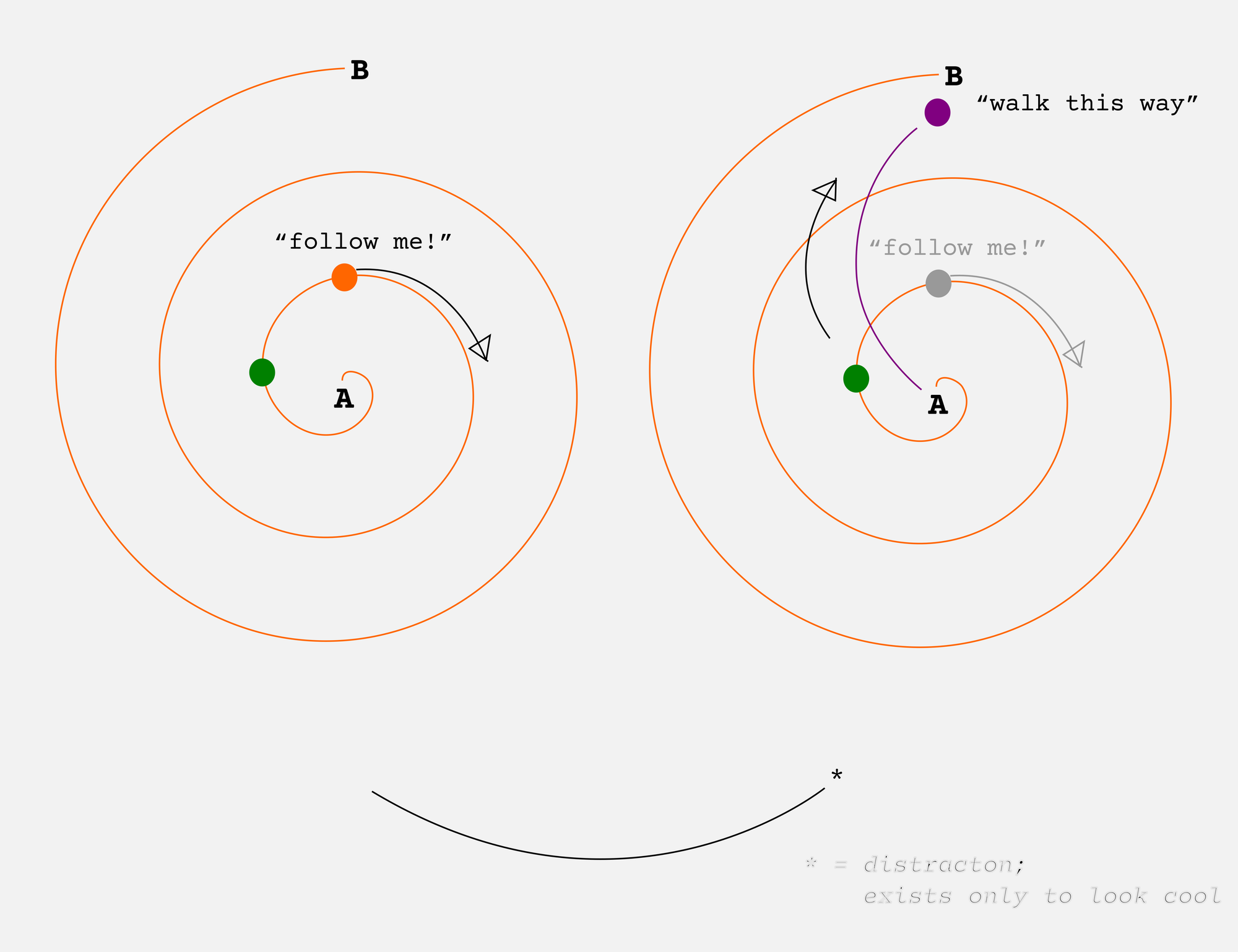
As far as I can tell, approximately nobody's development follows a straight line toward a destination.
Even with simple skills, like, say, swimming a certain distance faster, following the advice of someone better than you might have suboptimal results. Because it's possible to "improve" using naïve optimization that makes you better in the short run, but worse in the long run.
A slightly more advanced student might try to improve the floundering student's back crawl, since that's what they're using, poorly, and the coach is using more skillfully. But anyone with actual experience will try to figure out why the student can't breathe properly doing front crawl. First it will be slow, then it will be fast, which, in the long run, is much better than getting quick gains and then plateauing at a local optimum (very fast at a very slow stroke).
(A wiser mentor, even if they took a circuitous path, might, in hindsight, be able to see that the path they took isn't the best path. However, it's also possible that the shortest/fastest path is not the best one for a particular student, for reasons that are opaque even to the wise mentor. Perhaps, if the wise mentor were even wiser, they would see that the detours are, in this case, necessary. So, in the case of my illustration, a wiser wise mentor could have taken the direct route or the spiral route, and might recommend the route they took or the other route, depending on circumstances. However, as long as the game is in play, there's perhaps a limit to the knowledge of even the wisest of the wise.)
But getting a fancier coach isn't the whole answer, because of the problems I mentioned in Iteration: the scarcity of expert-time, expert-access, and expert-patience, as well as difficulty stepping down expert advice to a level that can be understood and applied by the student. (The difference between an expert and a teacher is, I suppose, whether the stepping-down is bundled with the expertise.)
My solution is, go ahead and learn from the person just ahead of you, but verify what you've learned with a true expert.
When I did my lifeguarding pre-requisite course, I found coaching from a more advanced student more helpful than coaching from the instructors. The advanced student had just learned what I was trying to learn. It was fresh, rather than muscle memory. The instructors would explain some new stroke: I’d try it, and it would totally fail to work. I'd watch the instructors do it, but they made it look so effortless I couldn't even tell what was going on. So I'd ask the more advanced student if he'd gotten it to work, and he'd say, yeah, by ignoring what the instructors said, and doing what felt intuitive. I managed to get the imperfect intuitive version to work, which got me from zero propulsion, to enough propulsion I could continue practicing the stroke without sinking.
If I continued to just do that version, I might end up with some bad habits. But from there, I could try to make it look more like what the instructors were doing, and then ask them, does this look right?
In the AI world, the cool kids often run cheap dumb models to do the grunt work, and smart expensive models to do the planning and the evaluation. In business, it's the same, with high paid people monitoring and correcting, and low paid people doing the work.
(As much as it pains me to suggest that the AI and business junkies are onto something, they are. But it's an idea they stole from the structure of the human brain and/or an ant colony, so we don't need to give them credit.)
We need multiple mentors, some far ahead of us, and some just ahead of us. That way, I can spend most of my time learning the practical details of the skill from the person just ahead of me, and then occasionally check in with the real expert, to make sure I'm going the right direction, and haven't ended up copying the intermediate student's flaws along with their skills.